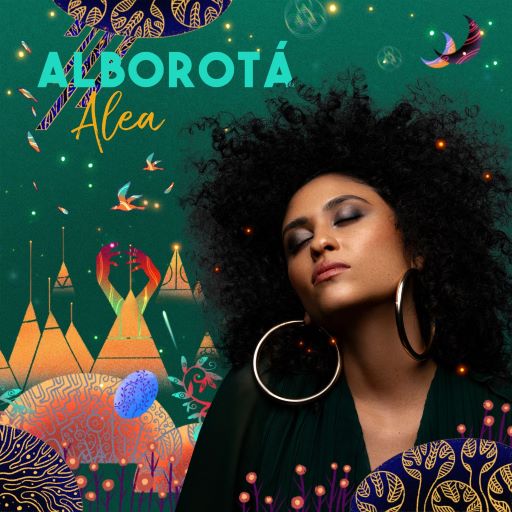
Alea, the Colombian born/Bronx based singer songwriter released her new album Alborotá
today. Alea’s vision spans ten diverse tracks that breaks the
traditional Latin music mold. The album uniquely blends Latin folklore
inspired by cumbia, porro, currulao and huapango with pop, afro and
savory Latin grooves filtered through her personal lens of strength,
feminism, and perseverance. She explains, “I decided that I couldn’t let
other people and the environment dictate my freedom, who I chose to
love and how I decided to speak about my truths. My music became a
reflection of that. To be bold, fierce and unapologetic.” Alea has been
releasing singles and music videos from the album for the past two years
with “Échale Sal” being hailed as one of NPR Alt.Latino’s favorite songs of 2020. Now she is ready to release her full album rooted in female and Latinx empowerment.
The album title Alborotá
is deeply personal to Alea. Alborotado(a) translates directly to rowdy,
riotous, loud, disorderly; and in most of Latin America it means being
too much, too different, too sexual. Alea elaborates, “I was called an
alborotada growing up by my family and friends because I was extremely
driven by creativity and imagination. I fought hard to keep true to this
nature, but this judgment took a toll on me as a I got older, and I
started to believe that I was the problem. My body was the problem, my
womanhood was the problem.” She adds, “I decided it was time to redefine
this word, to give it a new meaning in my life and use it as a flag
that represented being free, different, independent, out spoken, equal,
feminist. I named the album Alborotá
because it defines who I am now and what I wish to share with others,
this inner fire of strength and overcoming difficulties that liberates
you and celebrates you in every way.”
Alea produced the entire album with Sinuhé Padilla Isunza at Jarana Records.
Taking from his background of Mexican, Brazilian and Flamenco music,
Sinuhé set the tone of the album with an organic and authentic vibe
created with only acoustic instrumentation; a rarity in these digital
times. The album shines with the help of Alea’s friends and
collaborators including Latin GRAMMY winning artists Felipe Fournier (vibraphone on Échale Sal), Luisa Bastidas (violin on Alborotá) and Jackie Coleman (trumpet on No Me Apaga Nadie) of Flor de Toloache, and Latin GRAMMY nominee Sonia De Los Santos (vocals on Tú, Solo Tú). Alea adds, “Among them we also featured world class artists like Renee Goust, Elena Moon Park, Jaime Ospina, Miche Molina, George Sáenz, Juan Ruiz and Kika Parra. Our rhythm, our lock and groove was set by the incredible Franco Pinna on drums. We also had the help and ears of friends like Kamilo Kratc, Nacho Molina and Luis F. Herrera,
who listened to mixes and gave us feedback. All arrangements were
written by Sinuhé Padilla-Isunza and myself. The entire album was
mastered by GRAMMY winner, Luis F. Herrera.”
The results of recording over the past
years have yielded an album that Alea is really proud of, and rightfully
so. Alea has been sharing singles and music videos in real time, which
showcases the diversity and vision of each track. The album kicks off
with “Échale Sal,”
which Alea describes “…talks about what each of us contributes to our
communities, what we bring that makes us unique and that becomes the
engine of a conglomerate like New York, Medellín or Bogotá. It is the
struggle and the hope that unites us and makes us essential….This song
reminds me of everything we’ve done to survive and find dignity in a
place where we are called immigrants.” The music video brings it to life
thanks to the direction of Elyssa Budd.
The title track “Alborotá”
is a fine feminist declaration that celebrates each being that
identifies as a womxn. Alea passionately adds, “Alborotá describes my
story, as well as that of thousands of womxn that have had to conform
themselves to roles and expectations imposed on them by society.
However, liberation occurs for these womxn when they finally break the
silence on issues like identity, sexual abuse, and inequality. Being an
Alborotá is an act of courage that transcends gender; it is being true
to who you are and fighting for your dreams and beliefs in spite of what
people have to say.” The music video visually celebrates womxn with the
help of Tobías Arboleda and Elyssa Budd once again. “Aire Gaujiro” is a
homage to Alea’s home; La Guajira, a forgotten state in the north coast
of Colombia, bordering with Venezuela. People here love and breathe
Vallenato, it’s almost what Country music is to Nashville. Alea states,
“Women don’t usually sing or perform vallenato as it is considered
masculine, but I wanted to challenge that norm and represent in a genre
that I considered wasn’t for me for so long.” Another great music video
accompanies the song with help from Tobías Arboleda and Valeria Aviña.
The
next video dropping from the album is for “No Me Apaga Nadie.” Alea
mentions “The title refers to the fire within, the fire that you are.
Not permitting anyone dim you down. It’s a call to be rebellious and
free in a society where you have to claw your way in to be part of the
conversation.” These are just a few highlights from an album by an
artist who is poised to have a breakout year.
Alea
concludes, “I wanted to write an album that spoke about my roots as a
Colombian afro-indigenous woman. So this was also an exploration of
identity, one that I wasn’t close with until I moved far away and
somehow labels became a permanent part of who I was. I had to honor
these roots because it felt like a calling. Many dreams of spiritual
encounters and re-signifying the pain of being a Latin American woman
taught to be silent. With this album we explored realms of music from
cumbia to currulao, from a huapango to a vallenato, from folkloric rap
to ranchera music; we were bold and authentic. I’m really proud of this
work. It was not an easy road, but we did it!”
Stay tuned as Alea will be touring to support Alborotá throughout 2021 and into 2022!