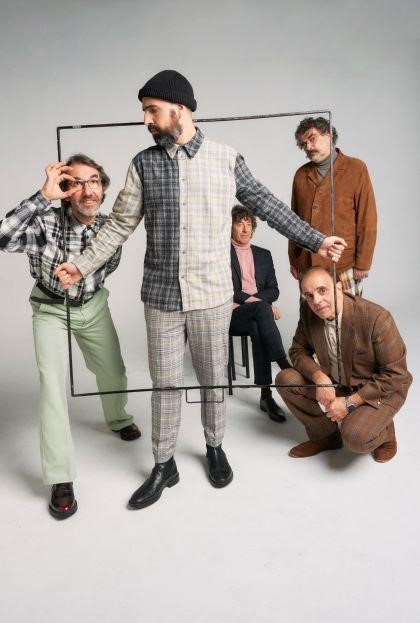
El Cuarteto de Nos have finally released their album Lámina
Once, and perhaps the first question we have to ask is: why did the
band choose that title?
The cover art alludes to the famed Rorschach test, which
uses psychology to study personality based on the data that emerges from what
someone sees in a series of ten slides. These images are known for being
ambiguous in their meaning, allowing the personality of the subject to be
shown.
“Lámina once” (“Slide eleven”), or la lámina que no está ("the
slide that isn’t there”), consists of eight distinctive songs: “Flan”, “Chivo expiatorio”, “Cinturón gris”,
“Fiesta en lo del Dr. Hermes”, “Frankenstein Posmo”, “La Ciudad sin alma”,
“Maldito show” and “Rorschach.”
There is a common undertone in all of them: the expression of a
discontent with what we are living in modern societies, the misery of the
present moment.
The album poses a fundamental philosophical question: how can we
lead an examined life?, and
it’s that there’s a connecting thread in the songs that reveals the obstacles
to leading that life. Contemporaries could merge the challenge in being
authentic, corruption or ethical fragility in that question, which has a
personal feel but also a relational and social reverberation. As El Cuarteto
always does, the album presents a critical view and the call for a certain
ethical standard in addressing today’s key issues. And it allows us to stand
back and reflect on whether we couldn’t have a better life.
It’s not surprising that Cuarteto de Nos decides to examine
and reflect on the present and on contemporary life. Topics such as the use and
management of information, the biases that it generates, the pulse of the
algorithm, taking or not taking sides, in how that affects the social fabric,
“being inside or outside.” Apportioning blame, identifying differences,
putting on disguises, drawing quick conclusions based on minimal information,
processing a myriad of situations with the levity of the ephemeral, knowing
very little about everything and a lot about nothing.
Lámina Once features the production of Eduardo Cabra (Visitante) and Héctor
Castillo, two friends from home
with whom the band had already worked on their previous album “JUEVES.”
Recorded during the pandemic between Montevideo, Puerto Rico and New York, this
is the first album they have released under their own label PORFIADO RECORDS.
The album’s aesthetic is outstanding, shaped by hand and striving
that every song has its own image related to the test. As the song “Rorschach”
mentions, “what can I do, if I only see spots,” each viewer will have the
opportunity to perform the exercise of letting their mind fly and discovering
what they see. Executed by Estudio Bruster in Uruguay, the art of Lámina
Once without a doubt artistically depicts the album’s concept.
The release of Lámina Once occurs simultaneously with the
video for the song “Rorschach,” which was produced by Oriental Films in Uruguay and
directed by another old acquaintance of the band, Charly Gutiérrez, creator of
Cuarteto de Nos’s legendary videos, such as “Ya no sé qué hacer conmigo” or “El
Hijo de Hernández.” Inspired by specific scenes from movies that share visual
features of the SCI FI horror genre, “Rorschach” explores a cinematic
language full of visual assets, a sense of fear and fascination, and a
nostalgia for the retro and analogue. “Rorschach” is a nod to fans
of the golden age of the genre, a tribute to movies such as The Blob, Altered
States, Poltergeist, Firestarter, and Hellraiser.
Spots that take on a life of their own,
experimental psychiatric treatments, supernatural powers, strange steaming
green stones on the floor, a TV that doesn’t stop emitting sound, elements that
defy gravity. Roberto, armed with his poetry, rebels against
that imposition that comes from the outside, against those who watch him,
against those who “believe that their story is the only truth.” Set
in the former home of Uruguay’s ex-president Juan José de Amézaga, an abandoned
site with peeling walls, once glorious and flamboyant, now in ruins, the video
has an explosive visual style, dark and very cinematographic. Always in motion,
we follow the spots that awaken Robert on a couch. From there on, the rhythm is
high voltage.